
 Back
Back-
 Finance Guidance and Claims Templates
-
Change Request Forms
-
Report and Review Templates
-
Gender Equality, Disability, and Social Inclusion
-
Risk Management
-
Monitoring, Evaluation and Learning
-
Safeguarding
-
Workshops and Webinars
-
Communications Toolkit
-
Learning and Evidence
-
Terms and Conditions
-
Frequently Asked Questions
-
Advisory Group Resources
Gender Equality, Disability, and Social Inclusion
The Biodiversity Challenge Funds (BCFs) commit to being a Gender Equality, Disability, & Social Inclusion (GEDSI) Sensitive programme.
In order to meet a GEDSI Sensitive standard, as defined by the BCFs, all successful projects must demonstrate they:
- Understand the GEDSI context in which the project is working within.
- Ensure inclusive and meaningful participation of all those engaging with the project.
- Will not contribute to or create any further inequalities i.e. “do no harm”.
Please see the BCFs GEDSI Ambition Statement for further information.
You may also find it useful to refer to the BCFs Gender Equality and Social Inclusion Webinar, March 2025.
For more information on how to meaningfully consider GEDSI in your project, please see the following resources:
Please note the BCFs adjusted the terminology from ‘Gender Equality and Social Inclusion’ to ‘Gender Equality, Disability, and Social Inclusion’ in September 2026 to align terminology with wider Defra programming. While Disability Inclusion was previously considered to be included within Social Inclusion and should already have been a consideration, applicants and projects should be aware of this change.
The above webinar was held prior to the change in terminology and therefore refers to ‘Gender Equality and Social Inclusion’.
Definitions
Gender Equality, Disability, and Social Inclusion is comprised of three key terms; the BCFs define these as follows:
Gender Equality: is about addressing inequalities and transforming the distribution of opportunities, choices and resources available to girls, women and non-binary individuals so that they have equal power to shape their lives and participate in the process thereby increasing equality between people of all genders.
Disability Inclusion: refers to the process of identifying, removing, and preventing barriers that limit the full and equal participation of persons with disabilities in society. It aims to enhance their access to opportunities, resources, services, and decision-making, enabling them to influence the social, economic, political, and cultural factors that affect their lives. It ensures that the rights, perspectives, needs, and contributions of persons with disabilities are recognised, respected, and meaningfully reflected in policies, programmes, and practices.
Social Inclusion: refers to the process of improving the terms of individuals and groups to take part in society, and the process of improving the ability, opportunity and dignity of people disadvantaged and historically excluded from decision making and spheres of influence on the basis of their social identities (such as ethnicity, age, class, gender, and disability) to take part in society.
The BCFs consider Indigenous People and Local Communities (IPLC) to be included within Social Inclusion as they have been disadvantaged and historically excluded from decision-making based on their identity.
Please see GEDSI Key Terminologies for further detail.
GEDSI Analysis:
Conducting a GEDSI Analysis is important in providing an insight and clearer understanding of the context a project is working within. These results can then be used to inform project design, ensuring inclusion and meaningful participation are embedded within the implementation of the project.
All applicants are required to conduct a GEDSI Analysis as part of their application and all projects asked to consider the principles of a GEDSI Analysis within their reporting.
For further details and examples on how to conduct a GEDSI Analysis, please see the following resources:
The slides from this video can be accessed here.
Please note this video was recorded prior to the change in terminology and therefore refers to ‘Gender Equality and Social Inclusion’ terminology.
How to meaningfully consider Social Inclusion:
To fully consider GEDSI within your project, you must consider all aspects of Gender Equality, Disability, and Social Inclusion.
The completion of a GEDSI Analysis will help you identify key barriers to participation and inform the actions required to address these inequalities. When conducting this analysis, projects and applicants should acknowledge the ways in which various social identities such as ethnicity, age, class, sex, and disability interact to inform how an individual or group are affected or impacted by the various GEDSI Analysis principles.
Please see the following resources for further information:
Reporting on GEDSI:
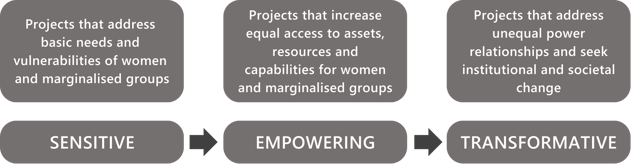
All projects will be required to self-assess against the BCFs GEDSI scale within their Annual and Final Reports, providing evidence to support their assessment.
All projects are required to meet the minimum standard of GEDSI Sensitive, as outlined above, and encouraged to push beyond to deepen and improve their GEDSI contribution where they can.
The diagram below outlines the three aspect of the GEDSI scale and descriptions for each:
Please see the following resources for some top tips on how to approach data collection:
- Practical tips for GEDSI Responsive data collection
- Practical tips for asking GEDSI Responsive questions